Just 111 non-budget bills so far this session
Of the over 4000 bills introduced this session in the Pennsylvania General Assembly, just 134 have been enacted. 111 were non-budget bills.
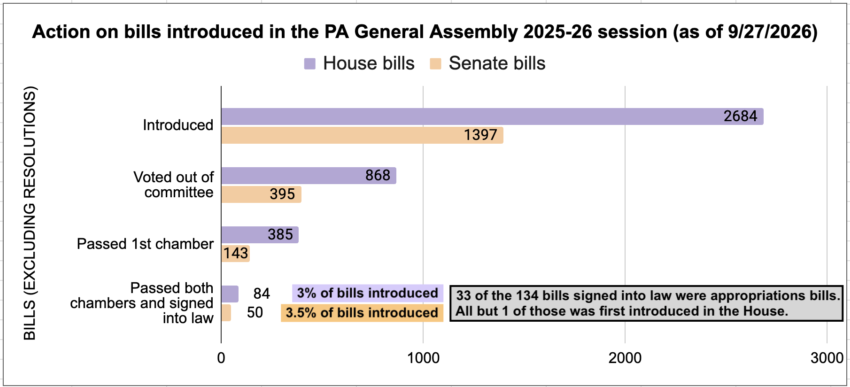
Monday, September 28, is the first day Pennsylvania’s full-time legislature is back in session after 11 weeks away. Amendments to the PA Constitution are no longer viable in this session, including House Bill 31/Senate Bill 131 for a citizens redistricting commission. For nearly 4,000 other bills there is still time enough for action, but only barely.
The House and Senate each have only 11 session days currently scheduled. With so few days remaining, and the House and Senate scheduled for alternate weeks in November, any bill still in its original committee will need to come out of committee in the next 5 session days to succeed. After October 6, there is not enough time to get through both chambers unless more days are scheduled.
2,818 bills are still sitting in their original committees (1,816 in the House, 1,002 in the Senate).
Currently, for our full-time legislature:
- Only 13 of 26 House Committees have scheduled a voting meeting Sep 28–30, to consider 27 of the 1,816 House Bills.
- Only 5 of 21 Senate Committees have scheduled a voting meeting Sep 28–30, to consider 6 of the 1,002 Senate Bills.
There are no committee meetings scheduled to consider bills after Sep 30 in either chamber.
Find committee schedules and bills to be considered on the House Committees schedule and the Senate Committees schedule. (This includes only bills—not resolutions—and committee meetings to vote on bills. There are also 4 House committee meetings scheduled to vote only on resolutions.
Find House Committees schedule
Find Senate Committees schedule
PA legislative leaders may be quick to point out that the very low number of bills enacted is a result of the current divided legislature, with a D majority in the House and an R majority in the Senate.
Yet divided assemblies in other states with even part-time legislatures have historically considered and passed far more bills than have been enacted in this or past PA sessions. And voters from both parties could easily point to many bills, so far ignored in both chambers, that share broad bipartisan support.
House Bill 31 and Senate Bill 131 are examples that come to mind. Majority leaders and State Government Committee chairs in both chambers refused to allow consideration or a vote on the bills, despite large numbers of cosponsors.
Some PA legislative candidates have made legislative reform part of their campaign platforms.
Most notable: Nathan Wood, once a House District manager for PA GOP Chair Senator Greg Rothman, now running against him in Senate District 34. Candidate Wood has made legislative reform the top agenda on his campaign issues page. As his page explains:
“Despite being richly compensated for their full-time work, Pennsylvania’s General Assembly passed a mere 65 bills last year - one of the least productive sessions in decades. In part, this is because PA majority leaders and committee chairpersons have enormous discretion over legislative agendas and can effectively block legislation by never scheduling it for consideration. Many good proposals die simply because our legislators refuse to debate them.”
Wood is not alone in his support for reform of PA’s legislative process, although he is the most explicit in proposing changes. Senator Tracey Pennycuick, answering Fair Districts PA’s Know Before You Vote survey, wrote:
“I frequently hear from constituents who are tired of seeing bipartisan legislation they support die unnecessarily because of the process. Government works best when good ideas can move forward on their merits, which is why I support changes to ensure bills with clear bipartisan support can be debated and voted on in the legislature.”
Many legislators indicated support for changes to procedural rules to ensure bills with clear bipartisan support receive a vote in committee and both chamber floors. As Senator Lisa Boscola noted, “I think every piece of legislation deserves at least a vote in Committee.”
Find your own candidates’ response regarding changes to procedural rules on our Take Action: Know Before You Vote webpage.
Find Know Before You Vote Info
Visit the Fix Harrisburg site for more information about PA’s legislative dysfunction, stories of bipartisan solutions that never get a final vote, reports on recent legislative sessions, and proposed solutions.